

Request a FREE ARBICO Organics Catalog more details »
|
|
|
|
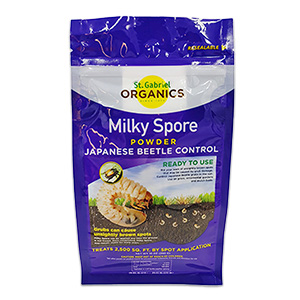
By: Mary Anne, Arbico Organics August, 2007 Oh no, here we go... the Japanese Beetles (Popillae japonica) have surfaced once again to begin their devastation of the garden. Beautiful little metallic green and copper creatures, just under a half an inch in length, you wouldn’t think they would be state enemy #1! Originally this pesky pest could only be found in states east of the Mississippi, but they have begun showing up in isolated populations as far west as California. And as you surely know, they love to munch on a wide range of fruits, ornamentals, and vegetables, including more than 300 different plant species. While a single beetle does not eat much, these guys like to get together and "throw large parties" of group feedings from the top of the plant, down. They feed on the soft plant tissues, completely "skeletonizing" the leaves, devour the flowers, and in these large parties can completely defoliate the plants they feed upon. So what do we do about it? The first rudimentary approach (for small infestations) is to get up early in the morning and go out and pick beetles. Remove or shake the beetles loose from the plants. You can shake them into a soapy pail of water as you go along to kill them. Direct spray applications of insecticidal soap kills Japanese Beetles on contact but does not provide any residual protection. Of course, Pyrethrum is the best organic insecticide treatment against Japanese Beetles. We have many choices to choose from that use Pyrethrum as the active ingredient. For large areas, I would recommend that you buy the PyGanic EC 1.4. This is a pyrethrum concentrate that is sold in economical sizes and is effective against hundreds of insects, including the Japanese Beetle. If the water in the area to be treated is alkaline, you would have to consider adding Citric Acid to lower the pH to a mid-range of 5.5 -7. A natural wetting agent can be added to the PyGanic application to increase the residuality of the insecticide applied, and it can help the plant recover from the damage. For our loving customers who are anti-kill, we would recommend that you use Neem extracts applied directly to the plants. This can deter Japanese Beetles from feeding, and Neem applied directly to the soil can interrupt insect reproduction. We have many products that have Neem oil as the active ingredient. Check out Grub Beater or the Safer BioNeem for garden applications. Also, our Bon-Neem is a fabulous combination of insecticidal soap and Neem oil. However, please keep in mind that Neem can be damaging to plants that are herbaceous or "sensitive," and in those situations, you would have to use a Pyrethrum. The Japanese Beetle will feed for about 4 to 6 weeks, and then the Females lay eggs in the soil under grasses in late summer. The beetle larvae (grubs) overwinter in the soil and begin feeding on the plant roots in the early spring. They pupate in early summer, and the adults emerge in late June and July, and the feeding begins again. In the meantime, the grubs love to ruin your lawn by feeding on the roots of grasses, which leaves large yellow patches. The beginning of the fall season is when you can plan ahead and gain control of your Japanese Beetle problem. You want to till soil in the gardens to expose the grubs to birds and other predators. You want to aerate your lawns. In late summer, or early fall, you need to apply our Beneficial Nematodes NemaSeek (Heterorhabditis bacteriophora), along with our Milky Spore (Bacillus popillae) to assure optimal results of an effective control against these damaging grubs. Milky Spore only has to be applied once, but we recommend that you treat again with NemaSeek in six months to further distribute the Milky Spore and to eliminate any new developing grubs. Make this your last year of tolerating these destructive invaders! ![]() Recently Viewed |
||||